

Verimatrix Streamkeeper
Hunt down and take out piracy.
Streamkeeper combines digital content security with app protection to defend against piracy.
Talk to us to discuss your video security requirements.
On this page
Stop pirates with Streamkeeper.
Our best-in-class products to stop digital piracy:
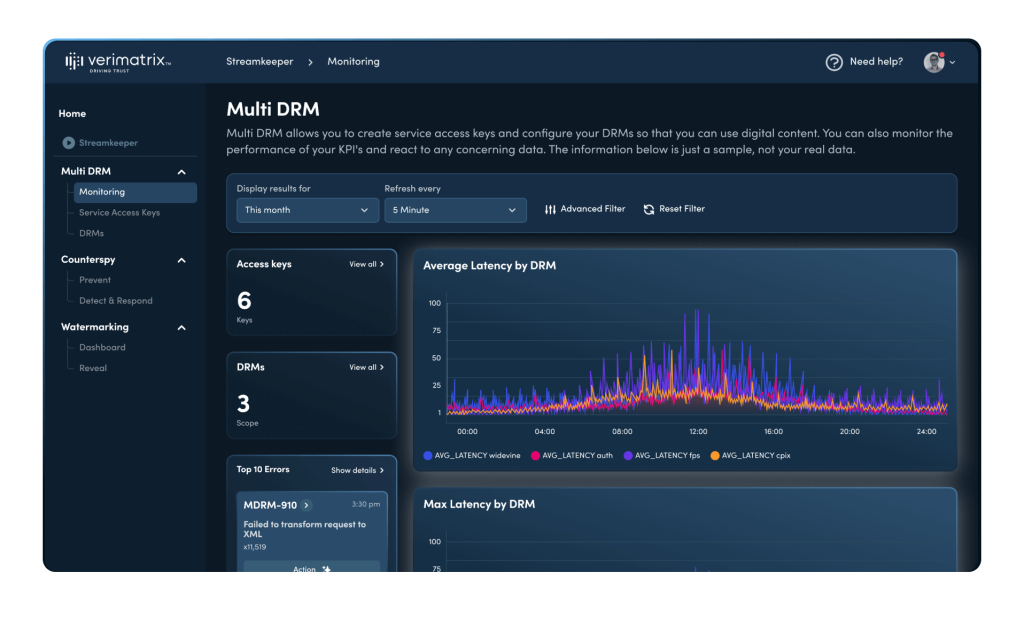
Multi-DRM
Studio-grade rights management to securely deliver video.
- Feature-rich security.
- Manage user entitlement on one unified system.
- Open APIs for seamless integration.
Counterspy
Robust detection & response combined with app shielding to shut down piracy.
- Real-time piracy detection
- Automated countermeasures such as service termination, quality degradation, warnings.
- Powerful app shielding technologies and robust monitoring.
Watermarking
Forensic client and server-side watermarking identification to trace and reveal content theft.
- Rapid identification
- Fast, convenient and automated Trace & Reveal service.
- Streamlined deployment with numerous pre-integrations.
Or, upgrade to the full anti-piracy suite:
Streamkeeper Suite
Stop digital piracy with the full anti-piracy suite that includes:
- Multi-DRM
- Counterspy
- Watermarking
Why choose Streamkeeper?
We provide operators confidence in their ability to protect their investment in content.
Built to fight against industrial-scale attacks.
Predict risks, track trends and infringement.
Actionable analytics refined by AI and machine learning.
Achieves MovieLabs compliance and follows industry best practices.
Fast integration with zero-code anti-piracy tools.
Designed for functionality and speed.
Not sure which Streamkeeper solutions are best for you?
We will help you find the right anti-piracy tools for your needs.
Streamkeeper helps you achieve compliance with ease.





As an ISO certified company (9001 and 27001:2022), Verimatrix helps businesses achieve compliance and meet the tough regulatory standards of industries.
Recognised by industry analysts and associations.

Product of the Year Award
2023 NAB Show

Winner: Best Content Protection Technology
CSI Awards 2022
Our customers rely on Streamkeeper to protect over 500M+ clients across devices.
















Talk to us
Modernize network security, protect content from piracy, and achieve studio compliance with Verimatrix. Get your free consultation by completing the form.
We’re here to help
- Find the right solution for you
- Point you to relevant resources
- Explain our pricing
Trusted and Recognized
By industry analysts, associations, and peers








Trusted and Recognized
By industry analysts, associations, and peers