
Forensic Watermarking
Managing digital content throughout an ever more complex - yet increasingly compressed - media lifecycle, while attempting to maximize the associated asset monetization, is presenting rights owners with new opportunities as well as threats. After the costly loss of control of recorded music distribution, the motion picture industry has also become severely impacted by content piracy. Worldwide loss of business for that particular industry and other content owners presents significant challenges not only to established distribution channels, but now even more so given that content increasingly finds its way beyond the traditional outlets. The media lifecycle is constantly morphing in often unpredictable ways, raising the bar for rights owners and technology providers alike.
The Promise of Watermarking
In response to the ever-shifting media monetization challenges, a variety of techniques are being developed and deployed to help address the protection of video content over its full lifecycle. One of the most promising of these techniques is “forensic watermarking.” The use of watermarking for digital video content, which draws on long established technologies combined with new and innovative approaches, has many promising aspects that directly address key challenges in the fight to maintain and enhance the revenue potential in content distribution systems.
Get more details about Verimatrix Watermarking Technology Ask a question or request a meeting |
A Powerful Solution – Digital Watermarking
Digital watermarking is a technology that seeks to securely, robustly and imperceptibly embed identifying information within copies of media content. These aspects benefit from some amplification:
- Imperceptible marking is required to preserve the quality of the viewer experience and avoid any implication that the delivery channel that uses watermarking reduces the integrity of the original material. Imperceptible marking draws a specific contrast to some visible overlay techniques used to help trace illegitimate channel rebroadcasting.
- Security is necessary to preserve the integrity of the inserted information, and especially to prevent any modification of embedded watermark information as copies are distributed.
- Robustness ensures that the watermark remains readable through any reasonable manipulation or transformation of the media. The most robust watermarks will survive multiple transitions from digital to analog format and be unaffected by filtering and distortion.
In comparison to other digital media such as audio, digitally distributed movies and other high value content can be protected particularly well by digital watermarking. Digital video is a composition of many individual images, with a much larger amount of data than other media files. Therefore it offers more scope to robustly embed information, when suitable technologies are applied. With advanced methods that make use of the density of information to insert watermarking payloads, video can be more effectively secured than audio or textual media. The relative sizes of content and payload make it difficult to remove by processing, re-encoding or even targeted filtering attacks.
Video Watermarking for Forensic Tracking
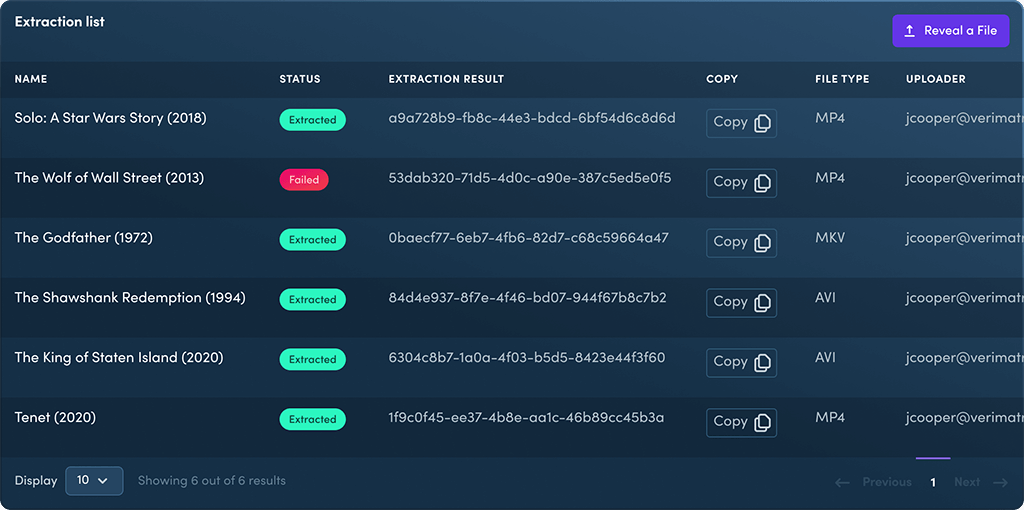
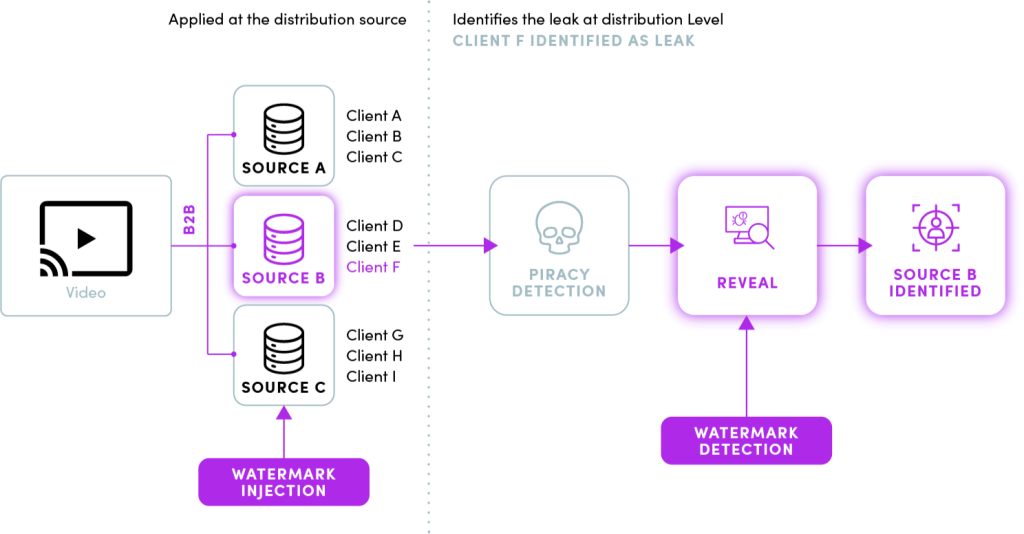
A specific application is the so-called user-specific forensic tracking, the goal of which is to help identify the source of unauthorized copies of media files and trace them back to the last authorized recipient or the legitimate content owner. User-specific forensic watermarking is an application that embeds a timestamp and identifying data, e.g. the service operator, content, transaction and end-user ID. This establishes a virtual “chain of custody” for content that accurately identifies the source of unauthorized copies, and which hence provides a valuable tool in potential legal actions against the perpetrator. Moreover, the presence of an identifying watermark will no doubt serve to deter piracy if the user is made aware - beforehand - that the content is traceable to the last authorized recipient. Thus, forensic watermarking is a key component of a layered content and revenue protection strategy.
Forensic Watermarking in the Media Value Chain
The application of watermarking is not limited to a single insertion point in the value chain. Instead, watermarking can be applied at various stages during the content distribution cycle: in the studio, in the distribution network, and finally in the receiver.
Moreover, multiple watermarks from different sources can in principle be applied to the same content and extracted individually later. Forensic tracing is thus enabled at multiple stages in the value chain, with the possibility to trace lost content to its last authorized user.
Verimatrix Watermarking Innovations and Solutions
Verimatrix has been investing in watermarking R&D for more than 10 years and is a recognized force in the practical application and commercialization of forensic video marking solutions. Watermarking and related techniques are important components of the company’s layered content and revenue security strategy. After pioneering watermark insertion in the video output of set-top boxes (STBs) and PCs with its VideoMark™ product, Verimatrix introduced another innovative revenue security tool, StreamMark®, for unicast and multi-device service delivery. Common to both solutions is an emphasis on invisible payload insertion, so as not to impact the consumer experience, while supporting the full range of features that content rights owners require, including legally defensible identification. Both solutions are trusted for marking and tracking early release window high value content.
Moreover, Verimatrix is the only company that offers fully integrated conditional access and watermarking solutions for managed as well as unmanaged networks.
| Product Characteristics | VideoMark™ | StreamMark® |
| Common Characteristics | Session based, user specific, forensic, robust, invisible watermarking. Robust against analog-digital conversion, recompression and other filtering. Security reviewed by third-party and accepted by major studios. | |
| Insertion Point | Client device. | Distribution network. |
| Content Marking Characteristics | Marking of baseband content during transcoding or playback. Pixel modification. Independent of compression format. | Marking of compressed content using compressed replacement data. |
| Payload Extraction | Original file not required. | Original file required as reference. |
| Media Pre-Processing | Not required. | Required. |